
Embracing a Plant-Based Lifestyle: A Journey to Holistic Wellness
- Shanely Barning

- Jul 22, 2025
- 5 min read
Updated: Oct 21, 2025
Hello, Curious Soul! Let's talk about eating behaviors on the journey to a plant-based lifestyle.
Embarking on this journey requires more than just swapping ingredients. It demands a thoughtful exploration of your existing relationship with food. This guide combines evidence-based nutrition principles with cognitive behavioral therapy techniques to help you transition mindfully and sustainably. By developing awareness of your current patterns, implementing reflective practices, and aligning your choices with personal values, you'll build lasting habits that support both your wellbeing and the planet. Whether you're just beginning to consider plant-based options or seeking to deepen your commitment, these practical strategies will empower you to make choices that truly nourish your body and mind.

Observing Current Plant-Based Eating Behaviors Without Judgment
Before making changes to your diet, it's essential to understand your current eating behaviors. Research published in the Journal of Nutrition Education and Behavior found that self-monitoring is one of the most effective strategies for sustainable dietary change. Participants who tracked their eating patterns were twice as likely to maintain new habits after six months (Burke et al., 2019).
Observation without judgment creates a foundation for intentional change. This means noticing not just what you eat, but also when, why, and how you eat. Are you reaching for snacks during periods of boredom? Do you eat quickly without savoring your food? Is your eating primarily habitual rather than in response to hunger cues?
It's particularly important to recognize that eating behaviors can be influenced by physiological factors beyond willpower. A 2018 study in the International Journal of Obesity demonstrated that hormonal fluctuations—whether from stress, menstrual cycles, or sleep deprivation—significantly impact hunger, satiety, and specific food cravings. Understanding these biological influences helps remove self-blame and fosters a more compassionate approach to dietary transitions.

"The first step toward change is awareness. The second step is acceptance." — Nathaniel Branden
A 2021 review in Nutrients highlighted that individuals who developed strong interoceptive awareness—the ability to recognize and respond to internal bodily sensations—were significantly more successful in transitioning to and maintaining plant-based diets. This self-awareness serves as the cornerstone for making informed choices that align with both physiological needs and personal values.
Practical Tools for Mindful Awareness
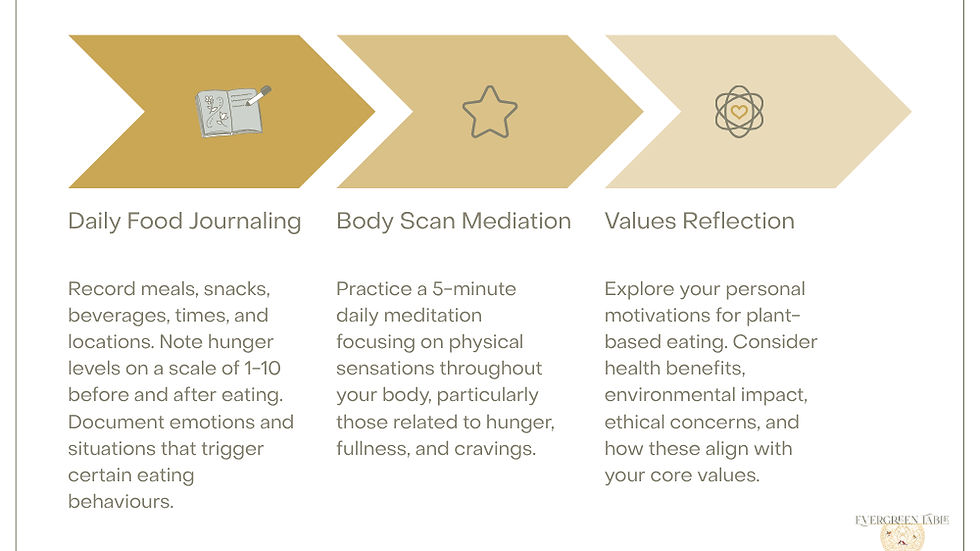
The Science Behind Mindful Eating Practices
Research consistently supports the effectiveness of these awareness tools. A randomized controlled trial published in the British Journal of Nutrition found that participants who maintained a food journal alongside mindfulness practices showed a 67% improvement in identifying true hunger cues versus emotional eating triggers compared to control groups.
Similarly, a 2019 study from Deakin University in Melbourne demonstrated that body scan meditation significantly enhanced participants' ability to detect subtle hunger signals and respond appropriately, leading to more balanced eating patterns and greater satisfaction with meals.

When implementing these practices, consistency matters more than perfection. Research from the University of Sydney found that participants who maintained even intermittent awareness practices reported significant improvements in their relationship with food within three weeks. The key is developing the habit of pausing before eating to check in with your body's actual needs rather than responding automatically to external cues or emotional triggers.
These tools become particularly valuable when navigating challenges in your plant-based journey. For instance, the journal Appetite published findings that individuals who practiced regular mindfulness were better equipped to handle social situations where plant-based options were limited, experiencing less stress and making more satisfying choices.
Reflective Prompts and Moving Forward
Journaling Prompts for Deeper Insights


A longitudinal study from Monash University found that individuals who regularly engaged with reflective prompts showed significantly greater adherence to plant-based eating patterns after one year compared to those who focused solely on nutritional information. The process of reflection appears to strengthen neural pathways associated with intentional choice rather than habitual response.
Supporting Your Ongoing Journey
Remember that awareness is an ongoing practice, not a destination. Research published in the Australian Journal of Psychology demonstrates that self-compassion during dietary transitions leads to more sustainable outcomes than rigid adherence to rules. Approaching your plant-based journey with curiosity rather than judgment creates space for growth and adaptation.
At Evergreen Table, we understand that personalized support can make a significant difference in your journey. A meta-analysis in the International Journal of Behavioral Nutrition and Physical Activity found that individuals with professional support were 3.4 times more likely to maintain dietary changes long-term compared to those working independently.

"The journey of a thousand miles begins with a single step. Your awareness today becomes your compass for tomorrow." — Shanely, Evergreen Table
As you move forward, remember that plant-based eating is not about perfection but progress. Research from the University of Queensland demonstrates that flexible, values-aligned approaches to dietary change result in greater psychological wellbeing and long-term adherence than rigid rule-following. By developing awareness now, you're building the foundation for sustainable choices that honor both your personal health and broader environmental concerns.
Take Your Journey Further
Free Resources
Download our complimentary Plant-Based Journey: Supporting Your Path to Success Workbook with daily prompts, tracking tools, and guided exercises to support your practice. This resource will help you build consistency and deepen your understanding of your relationship with food.
If you're ready to transform your relationship with food on a deeper level, I'm here to support you. Book a free 30-minute consultation to explore how personalized guidance could help you develop sustainable mindful eating habits tailored to your unique needs, preferences, and lifestyle.
This journey becomes even more powerful when shared. If you know someone who might benefit from mindful eating—perhaps a friend who struggles with emotional eating, a family member with digestive issues, or a colleague who always eats lunch at their desk—please share this guide with them.
Remember to nourish yourself with LOVE.

Remember, the journey to longevity is not just about adding years to your life, but about adding life to your years. Believe in your strength, embrace the possibilities, and step forward with confidence. Together, we can unlock the door to a vibrant, fulfilling future!
References and Further Reading
Why More Successful?
Tang, HB., Jalil, N.I.A., Tan, CS. et al. Why more successful? An analysis of participants’ self-monitoring data in an online weight loss intervention. BMC Public Health 24, 322 (2024). https://doi.org/10.1186/s12889-024-17848-9
Hormone Fluctuation
Introspective Awareness
RChammas, N., Brytek-Matera, A., Tornquist, D. et al. Profiles of intuitive eating in adults: the role of self-esteem, interoceptive awareness, and motivation for healthy eating. BMC Psychiatry 24, 288 (2024). https://doi.org/10.1186/s12888-024-05722-2
Mindful Eating
Body Scan
Humble, Gregory; Geddes, Harry; Baell, Oliver; Payne, Jake Elijah; Hill, Aron; Chung, Sung Wook; et al. (2025). TMS-EEG Shows Mindfulness Meditation Is Associated With a Different Excitation/Inhibition Balance in the Dorsolateral Prefrontal Cortex. Deakin University. Journal contribution. https://hdl.handle.net/10779/DRO/DU:28502435.v1
Disclaimer: Shanely Barning is not a health professional and cannot diagnose or provide healing in a coaching or clinical capacity. Please consult your own personal health professional. This information is for informational purposes only.*


Comments